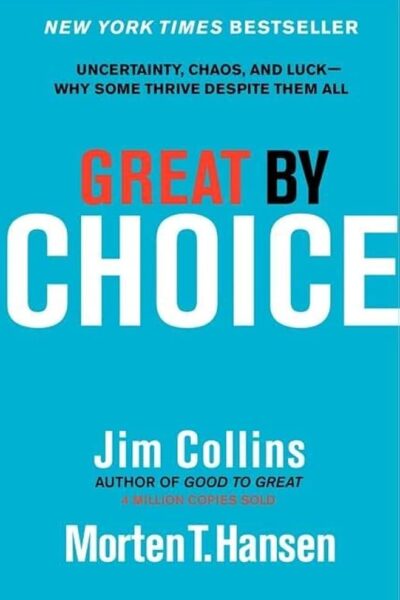
In an era of relentless change and unpredictability, some companies don’t just survive—they thrive spectacularly. Jim Collins and Morten T. Hansen’s groundbreaking book Great by Choice explores why certain businesses achieve exceptional performance in chaotic environments while others falter. Through rigorous research comparing “10X companies” (those that outperformed their industry by at least ten times) with less successful competitors, the authors uncovered powerful principles that challenge conventional wisdom about leadership and success.
The Core Question: Why Do Some Thrive in Chaos?
Collins and Hansen studied matched pairs of companies operating in the same turbulent industries during the same time periods. The question wasn’t whether companies faced uncertainty—they all did. The question was why some emerged as clear winners. What they discovered wasn’t about luck, innovation, or bold risk-taking, but rather disciplined behavior and specific leadership characteristics.
The 10Xer Leadership Profile
The research identified a distinct leadership profile among the exceptional performers. These “10Xers” shared three core behaviors that set them apart: fanatic discipline, empirical creativity, and productive paranoia.
Fanatic discipline means maintaining intense consistency of action—adhering to core values and strategic plans regardless of circumstances. These leaders didn’t get distracted by every new trend or opportunity. They showed remarkable self-control in both good times and bad, avoiding overreaching during booms and maintaining standards during downturns.
Empirical creativity involves basing decisions on direct observation, practical experimentation, and evidence rather than following conventional wisdom or relying solely on authority. The 10X leaders were highly creative and innovative, but they grounded their innovations in empirical validation through what Collins and Hansen call “firing bullets, then cannonballs.”
Productive paranoia describes the constant vigilance and preparation for worst-case scenarios even when things are going well. These leaders never felt entitled to success and always asked, “What could kill us?” This paranoia drove them to build cash reserves, plan for multiple contingencies, and stay hyper-vigilant about changes in their environment.
The 20 Mile March: Consistent Progress Over Bold Leaps
One of the book’s most powerful concepts is the 20 Mile March—a commitment to consistent performance markers that you hit year after year, regardless of conditions. The metaphor comes from imagining two teams racing to the South Pole. One team pushes hard when weather is good and holes up when it’s bad. The other marches exactly 20 miles every day, no matter what.
The 10X companies practiced their own version of the 20 Mile March, setting ambitious but achievable performance markers and hitting them with remarkable consistency. This approach required both self-control in good times (not overextending) and remarkable discipline in difficult times (not underperforming).
The 20 Mile March builds confidence through demonstrated ability to perform, reduces risk by maintaining steady progress, and creates a culture of delivery and discipline.
Firing Bullets, Then Cannonballs
Rather than betting big on unproven ideas, 10X companies first fired “bullets”—low-cost, low-risk tests to figure out what would work. Only after empirically validating an approach did they fire a “cannonball”—concentrating resources for a big bet.
This disciplined approach to innovation allowed these companies to be highly creative while minimizing risk. They weren’t necessarily more innovative than competitors, but they were more disciplined about how they innovated, avoiding catastrophic failures while still making bold moves based on calibrated evidence.
Leading Above the Death Line
Collins and Hansen introduce the concept of the “death line”—the point where a company suffers consequences so severe that recovery becomes impossible or extremely difficult. The 10X companies obsessed about staying far above this death line through building buffers, maintaining margins of safety, and preparing for unexpected shocks.
This meant maintaining cash reserves far beyond what seemed necessary, zooming out to sense changing conditions before others, and always having Plan B, C, and D ready. While this approach might seem overly conservative, it paradoxically enabled these companies to be more bold and aggressive when opportunities arose because they had the resources and stability to capitalize on them.
Return on Luck: It’s What You Do With It
Perhaps most surprisingly, the research found that 10X companies didn’t have better luck than their comparison companies. Both groups experienced similar amounts of good and bad luck. The critical difference was the return on luck—what companies did with the luck they received.
When 10X companies caught a lucky break, they recognized it and maximized it through disciplined action. When they experienced bad luck, their preparation and discipline helped them weather the storm. This finding demolishes the myth that exceptional success requires exceptional luck.
SMaC: Specific, Methodical, and Consistent
Successful companies developed a SMaC recipe—specific, methodical, and consistent practices that worked for them. These recipes were empirically validated over time and amended only with great discipline (typically changing only 20% or less over a decade).
The SMaC recipe provided clarity and consistency while allowing for tactical adjustments. It answered the question: What are the specific practices we will religiously maintain? This created stability in an unstable world.
Practical Applications for Your Organization
The insights from Great by Choice translate into actionable strategies for any organization:
Develop your 20 Mile March. Identify performance markers you can commit to hitting year after year, regardless of conditions. Make them demanding enough to stretch your organization but achievable even in difficult circumstances.
Practice productive paranoia. Build cash reserves, scenario-plan for various futures, and constantly ask what could threaten your success. Use good times to prepare for bad times.
Test before you bet. Before making major commitments, fire bullets to gain empirical validation. Learn what works through low-cost tests, then concentrate resources based on evidence.
Create your SMaC recipe. Identify the specific practices that work for your organization and commit to them with discipline. Change them only based on empirical evidence, not fashion or pressure.
Cultivate fanatic discipline. Develop self-control at both the individual and organizational level. Resist the temptation to overextend during booms or abandon standards during busts.
Why This Matters Now More Than Ever
In today’s environment of technological disruption, economic volatility, and unprecedented uncertainty, the principles from Great by Choice are remarkably relevant. The book demonstrates that success in chaos isn’t about predicting the future or taking wild risks—it’s about disciplined action, empirical decision-making, and consistent execution.
The companies that will thrive in the coming decades won’t necessarily be the most innovative, the best funded, or the luckiest. They’ll be the ones that combine creativity with discipline, ambition with paranoia, and boldness with empirical validation. They’ll be the ones that march consistently forward while others oscillate between overreaction and paralysis.
Great by Choice offers a research-backed framework for achieving exceptional results in uncertain times. Whether you’re leading a startup, managing a team, or running an established organization, these principles provide a roadmap for not just surviving uncertainty, but using it as a competitive advantage.