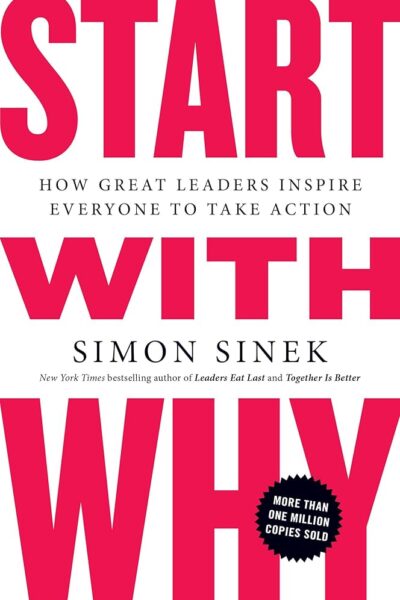
Simon Sinek’s Start With Why presents a deceptively simple idea that fundamentally changes how we think about leadership, marketing, and building organizations. The book argues that the most inspiring leaders and successful companies all think, act, and communicate in the same way, and it’s the opposite of how most organizations operate. They start with why. This concept has transformed how thousands of companies articulate their purpose and connect with customers, making it one of the most influential business books of the past two decades.
The Golden Circle: A Different Way of Thinking
Sinek introduces the Golden Circle, three concentric circles labeled Why, How, and What from the inside out. Every organization knows what they do. Some know how they do it. Very few know why they do it, and by why, Sinek doesn’t mean making profit. That’s a result. He means purpose, cause, or belief. Why does your organization exist? Why should anyone care?
Most companies communicate from the outside in. They start with what they do, maybe explain how they’re different, and expect people to buy. Apple could market their computers by saying “We make great computers. They’re beautifully designed, simple to use, and user friendly. Want to buy one?” That’s how most companies sell.
Instead, Apple communicates from the inside out. They start with why. “Everything we do, we believe in challenging the status quo. We believe in thinking differently. The way we challenge the status quo is by making our products beautifully designed, simple to use, and user friendly. We just happen to make great computers. Want to buy one?”
The information is almost identical but the order is reversed. Starting with why completely changes how people receive and respond to the message. It transforms a transaction into a relationship based on shared beliefs.
People Don’t Buy What You Do, They Buy Why You Do It
The book’s central insight is that people don’t buy what you do, they buy why you do it. This explains phenomena that traditional marketing theory struggles with. Why do people pay premium prices for Apple products when cheaper alternatives have similar features? Why did people support Martin Luther King Jr.’s vision of civil rights so passionately? Why do some brands inspire fierce loyalty while others are easily abandoned for cheaper options?
The answer lies in how our brains work. The outer section of the Golden Circle, the what, corresponds to the neocortex, the part of the brain responsible for rational thought and language. The inner two sections, the why and how, correspond to the limbic brain, which handles feelings like trust and loyalty and drives behavior and decision making.
When you communicate starting with what, you’re speaking to the part of the brain that processes rational information but doesn’t drive behavior. People understand what you’re saying but it doesn’t inspire them to act. When you start with why, you’re speaking directly to the part of the brain that controls decision making. People feel something. That feeling drives action, and then they rationalize it with the tangible things you do.
This is why we can list all the features and benefits of a product but still struggle to inspire purchase, while a company that communicates its purpose and beliefs creates customers who will camp overnight to buy their products.
The Biology of Why
Sinek grounds his argument in biology, explaining that the limbic brain has no capacity for language. This is why putting our feelings into words is hard. When a decision feels right, we often can’t fully explain why. We say things like “It just feels right” or “My gut told me.” That’s the limbic brain communicating.
This biological reality explains why starting with why works so powerfully. When you articulate a clear why, you give people language to describe what they already feel. When someone believes what you believe, they see your product or cause as a way to express their own identity and values.
The most loyal customers aren’t loyal because your product is better. They’re loyal because buying from you allows them to say something about who they are. Harley-Davidson customers don’t just buy motorcycles. They buy into a belief about freedom and rebellion. Apple customers don’t just buy computers. They buy into a belief about thinking differently and challenging the status quo.
Finding Your Why
Many people struggle to articulate their why. Sinek explains this difficulty stems from the fact that why exists in the limbic brain, which lacks language capacity. Your why is a feeling, a sense of purpose that’s hard to put into words even though you know it when you feel it.
Your why comes from looking back at your story. It emerges from your origin, your upbringing, the experiences that shaped you. For organizations, why often traces back to the founder’s original inspiration and the problem they felt compelled to solve.
Martin Luther King Jr.’s why wasn’t “I have a plan” about specific policies and programs. It was “I have a dream” about a better world he believed possible. That dream came from his life experiences and deep beliefs about human dignity and justice. The specifics of how to achieve it, the strategies and tactics, those were important but secondary to the why that inspired millions.
For businesses, finding your why means understanding what drove you to start in the first place. It’s rarely about making money. It’s about a belief that something should exist in the world that didn’t before, a conviction that things could be better, a vision of possibility that won’t let you go.
The Celery Test: How to Make Decisions
Sinek offers a practical tool called the celery test for making decisions consistent with your why. Imagine you’re at a dinner party and people give you advice about growing your business. One says you need Oreos. Another insists you need rice milk. A third recommends celery. Someone else suggests M&Ms.
Without a clear why, you might try everything, spending money and energy on things that don’t fit together or reinforce a coherent message. But if your why is about health and wellness, the decision becomes obvious. You buy the celery and rice milk. You ignore the Oreos and M&Ms. Your why acts as a filter for every decision.
This applies to hiring, partnerships, product development, and marketing. Does this decision reinforce our why or dilute it? Does this person believe what we believe? Does this opportunity help us advance our cause? A clear why makes difficult decisions simpler by providing a consistent standard against which to evaluate options.
The Golden Circle in Action: Southwest Airlines
Sinek uses Southwest Airlines as an extended example of starting with why. Southwest’s why is about freedom, making flying accessible to regular people who couldn’t otherwise afford it. Everything they do flows from this purpose.
They don’t assign seats because it speeds up boarding and keeps costs down. They don’t serve meals for the same reason. They fly to secondary airports where fees are lower. They operate a single aircraft type to reduce training and maintenance costs. Every decision supports their why of democratizing air travel.
This clarity allows Southwest to ignore what other airlines do. They don’t need first class cabins or fancy airport lounges. Those things contradict their why. Customers who share their belief about accessible travel choose Southwest not despite these absences but because of them. The lack of frills proves Southwest is serious about their purpose.
Compare this to other airlines that compete on what, offering similar products and services at similar prices. They end up in brutal price competition because customers have no reason to prefer one over another beyond whoever is cheapest. Southwest competes on why and attracts customers who believe what they believe.
The Importance of Discipline: The How
While why provides purpose and inspiration, how provides the discipline to bring that purpose to life. How represents your values, the principles and actions that make your why tangible. These are the things that differentiate you at a practical level.
Apple’s how includes design excellence, simplicity, and attention to detail. These values guide every product decision and make their belief about thinking differently real and observable. Southwest’s how includes low costs, efficiency, and fun. These values translate their belief about accessible travel into specific practices.
Without how, why remains an abstract aspiration. How provides the structure and discipline to consistently deliver on your purpose. It’s the bridge between the inspiring vision and the tangible results. Companies that articulate their why but lack disciplined how quickly lose credibility as the gap between what they say and what they do becomes apparent.
Consistency Matters More Than Authenticity
Sinek makes a counterintuitive point about authenticity. Being authentic means being true to yourself, but if you don’t know who you are or what you believe, authenticity provides no direction. You can be authentically confused or authentically inconsistent.
What matters more than authenticity is consistency. When everything you say and do reflects your why, people come to trust what you stand for. This consistency builds the trust that creates loyalty. Inconsistency, even if each individual action is authentic, creates confusion and erodes trust.
This is why companies that constantly chase trends or pivot their messaging struggle to build loyal followings. People can’t figure out what the company stands for because the company isn’t consistently expressing a clear belief system. Each campaign might be clever or authentic in isolation, but together they fail to build a coherent identity.
The Split: When Success Changes Everything
Many companies start with a clear why but lose it as they grow. Sinek calls this the split, the point where what you do becomes disconnected from why you do it. This often happens when founders step back and professional managers take over, or when success shifts focus from purpose to profit.
The split is dangerous because it’s gradual and hard to notice from inside. Decisions that seem rational in isolation slowly move the company away from its original purpose. You add products that don’t fit. You enter markets that aren’t aligned. You hire people who don’t share the belief system. Each choice makes sense financially but collectively they dilute your why.
Companies at the split often experience declining customer loyalty, employee disengagement, and increased difficulty making decisions. Without a clear why to guide choices, everything becomes about what: features, price, market share. The inspiration that built the company drains away, replaced by mechanical optimization of metrics.
Avoiding the split requires vigilantly protecting your why even as circumstances change. It means saying no to opportunities that don’t fit, even profitable ones. It means hiring for belief alignment, not just skills. It means constantly reminding everyone why the organization exists beyond making money.
The Law of Diffusion of Innovation
Sinek applies Everett Rogers’ diffusion of innovations theory to explain how movements and products gain mass adoption. The population breaks down into innovators (2.5%), early adopters (13.5%), early majority (34%), late majority (34%), and laggards (16%).
Most companies market to the early and late majority because that’s where the big numbers are. But the early majority won’t try something until someone else has tried it first. If you only appeal to the majority, you never achieve the tipping point needed for mass adoption.
Great leaders and companies target the innovators and early adopters first. These people make decisions based on what they believe, not what the majority thinks. They’re willing to stand in line for hours, pay premium prices, or endure inconvenience because a product or cause speaks to their beliefs.
Martin Luther King Jr. didn’t fill the National Mall by convincing the majority he had the right plan. He inspired innovators and early adopters who believed what he believed. They brought their friends and colleagues. The movement reached the tipping point of 15-18% of the population, and the rest followed.
For businesses, this means don’t worry if most people don’t get it at first. Find the believers, the people who share your why. Serve them exceptionally. Let them tell others. The majority will follow once enough believers validate the choice.
The Megaphone Versus Trust
Traditional marketing is like a megaphone. You broadcast your message to as many people as possible hoping some will respond. This is expensive and inefficient. Most people ignore messages that don’t resonate with their beliefs.
Starting with why creates trust instead. When you clearly articulate what you believe, you attract people who believe what you believe. These people don’t need to be convinced. They already agree. Your role is simply to give them a way to express their existing beliefs through your product, service, or cause.
This transforms marketing from persuasion to identification. You’re not trying to convince skeptics. You’re helping believers find you. This requires clarity about your why and courage to exclude people who don’t share it. You can’t be everything to everyone. The clearer you are about what you stand for, the more powerfully you’ll attract those who agree and repel those who don’t.
The companies that try to appeal to everyone end up standing for nothing. They chase every demographic and trend, diluting their message until it becomes generic. The companies that clearly state their beliefs and accept that some people won’t agree build devoted followings that sustain them through challenges.
Energy Versus Charisma
Sinek distinguishes between leaders who inspire through energy and those who inspire through charisma. Energy is external, the ability to motivate through incentives, penalties, or force of personality. It works in the short term but requires constant input. When the energetic leader leaves or the incentives stop, motivation evaporates.
Charisma is different. Charismatic leaders have clarity of why, an undying belief in a purpose or cause bigger than themselves. They inspire because their conviction is infectious. People follow not because of external rewards but because they believe what the leader believes.
Energy can move people to act once. Charisma creates movements that sustain themselves because followers become leaders who inspire others. Martin Luther King Jr., the Wright Brothers, and Steve Jobs all had charisma rooted in unshakable conviction about their why. People followed them through setbacks and obstacles because the cause mattered more than temporary difficulties.
For organizations, this means leadership isn’t about having the most dynamic personality or offering the biggest incentives. It’s about articulating a clear why that gives people something meaningful to believe in and work toward.
Starting With Why in Practice
Translating these concepts into action begins with doing the hard work of clarifying your why. This isn’t a marketing exercise or tagline creation. It’s genuine introspection about what you believe and why you do what you do.
Once you know your why, you must communicate it consistently in everything you do. Your marketing should start with why, not with features or benefits. Your hiring should prioritize belief alignment over credentials. Your product development should ask whether each feature serves your purpose.
This requires discipline because the pressure to abandon your why for short-term gain never stops. Competitors offer features you don’t have. Customers request things that don’t fit. Investors push for growth that requires compromising beliefs. Staying true to your why when easier paths exist separates companies that inspire from those that simply transact.
You’ll know you’re succeeding when customers describe your products or services in terms that reflect your why rather than your what. When they say buying from you helps them express who they are, when they become advocates who recruit others, when they remain loyal even when cheaper options exist, you’ve created something that starts with why.
Why This Matters for the Future
In an age of increasing transparency and infinite choice, starting with why matters more than ever. Customers can instantly research alternatives, compare features, and read reviews. Competing on what you do or how you do it becomes nearly impossible because someone can always copy or undercut you.
What can’t be copied is why you do it. Your purpose, your beliefs, your reason for existing beyond profit, these are inherently unique. They emerge from your specific story and values. When you build your organization around why, you create differentiation that competitors can’t replicate by matching features or lowering prices.
For individuals, understanding your why provides direction in an uncertain world. It helps you choose opportunities that align with your purpose and decline ones that don’t, even when they look good on paper. It gives you the conviction to persevere through obstacles because you’re working toward something that matters deeply to you.
For society, leaders and organizations that start with why create meaning and inspire contribution in ways that purely transactional relationships never can. They remind us that business can be about more than profit, that work can be about more than paychecks, and that we can build things that genuinely make the world better while also succeeding commercially.
Start With Why challenges us to think differently about success, leadership, and what it means to build something meaningful. It shows that the most inspiring leaders throughout history didn’t have better ideas or more resources than others. They had clarity of purpose that inspired people to follow. This clarity is available to anyone willing to do the hard work of discovering and articulating their why. The question is whether we have the courage to start there, even when it’s easier to lead with what we do or how we do it. Those who find that courage don’t just build businesses. They inspire movements that change the world.