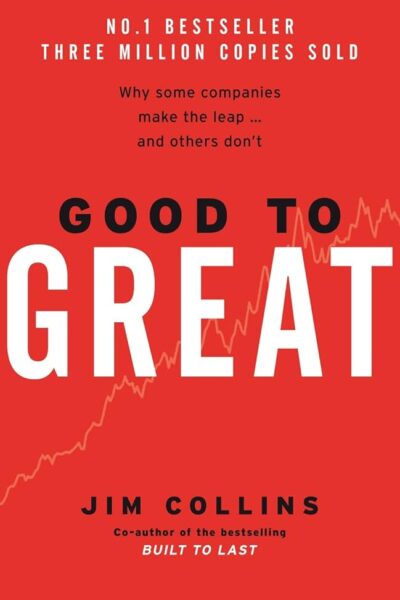
Jim Collins and his research team spent five years studying why some companies make the leap from good performance to truly great results while others plateau or decline. Good to Great presents findings from rigorous analysis of 28 companies over 30 years, identifying patterns that separate exceptional performers from their merely competent peers. While the book focuses on established companies rather than startups, its insights about discipline, leadership, and building sustainable excellence have profound implications for anyone trying to build something that lasts.
The Good-to-Great Study: A Rigorous Approach
Collins and his team didn’t start with theories and look for supporting examples. They started with data. They identified companies that experienced at least 15 years of exceptional stock returns following a transition point, significantly outperforming both the general market and their industry peers. Then they compared each good-to-great company with a direct comparison company in the same industry that had similar resources but never made the leap.
The companies that made the cut included Abbott, Circuit City, Fannie Mae, Gillette, Kimberly-Clark, Kroger, Nucor, Philip Morris, Pitney Bowes, Walgreens, and Wells Fargo. The team analyzed tens of thousands of articles, conducted extensive interviews, and studied financial data to understand what distinguished these companies from comparisons that remained merely good.
What makes the research compelling is its counterintuitive findings. The good-to-great companies didn’t have celebrity CEOs, didn’t launch massive change programs, didn’t make huge acquisitions, and didn’t follow the prescriptions found in most management books. Instead, they followed a disciplined pattern that Collins describes through several interrelated concepts.
Level 5 Leadership: The Paradox of Humility and Will
The research revealed that all good-to-great companies had what Collins calls Level 5 Leadership at the pivotal transition point. These leaders combined personal humility with intense professional will. They were ambitious, to be sure, but their ambition focused on the company’s success rather than their own fame or fortune.
Level 5 leaders display a compelling modesty. They shun public adulation and are never boastful. They attribute success to factors outside themselves, often crediting luck, other people, or circumstances when things go well. Yet they look in the mirror when assigning responsibility for poor results, taking personal accountability rather than blaming external factors.
This humility coexists with ferocious determination. Level 5 leaders are fanatically driven to produce sustained results. They’ll do whatever it takes to make the company great, including making difficult decisions that cause short-term pain. They set up successors for even greater success rather than choosing weak successors who make them look good by comparison.
The comparison companies often had Level 4 leaders, highly capable executives who catalyzed commitment to a clear vision and stimulated higher performance. But they lacked the humility and focus on institutional success over personal recognition that characterized Level 5 leaders. Many comparison companies hired celebrity CEOs with big personalities and bigger pay packages who delivered short-term results but left no lasting legacy.
Darwin Smith at Kimberly-Clark exemplifies Level 5 leadership. A quiet, humble executive who wore cheap suits and lived modestly, he transformed the company from a mediocre paper mill into the leading consumer paper products company. He made the gutsy decision to sell the traditional paper mills and bet everything on consumer products, a move that analysts called stupid but that ultimately defined the company’s success. When asked about his greatest accomplishment, Smith credited the people of Kimberly-Clark, not himself.
First Who, Then What: Getting the Right People on the Bus
Conventional wisdom says you need a clear vision and strategy before recruiting people to execute it. The good-to-great companies did the opposite. They got the right people on the bus, the wrong people off the bus, and the right people in the right seats before they figured out where to drive it.
This approach sounds backwards but offers crucial advantages. First, when you start with who rather than what, you can adapt to changing circumstances because you have people capable of figuring out the best path forward. Second, when you have the right people, the problem of motivation largely disappears. The right people don’t need to be tightly managed or motivated, they’re self-motivated by the opportunity to be part of something great.
Third, if the wrong people are on the bus, nothing else matters. You can have the right vision, the right strategy, and the right systems, but mediocre people will produce mediocre results. Getting the right people in place is the essential first step because everything else depends on having people capable of and committed to excellence.
The good-to-great companies were rigorous, not ruthless, about people decisions. They didn’t immediately fire everyone who wasn’t a top performer. Instead, they gave people opportunities to find the right seat where they could excel. But when it became clear that someone couldn’t or wouldn’t perform at the necessary level, they acted decisively to move that person off the bus.
This rigor extended to hiring. Good-to-great companies would rather leave positions open than fill them with the wrong people. They understood that having no one is better than having the wrong someone. A hiring mistake doesn’t just fill a seat poorly, it blocks the right person from eventually filling that seat and drains energy from everyone who must work around the weak performer.
Confront the Brutal Facts Yet Never Lose Faith
Good-to-great companies created a culture where people had tremendous opportunity to be heard and for the truth to be heard. They confronted the most brutal facts about their current reality while maintaining absolute faith that they would prevail in the end.
This principle seems contradictory but both halves matter equally. You cannot make good decisions without confronting reality honestly. Yet you also cannot sustain effort through difficulty without unwavering faith in ultimate success. The Stockdale Paradox, named after Admiral Jim Stockdale who survived eight years in a Vietnamese POW camp, captures this duality.
Stockdale explained that the optimists who believed they’d be out by Christmas, then by Easter, then by Thanksgiving, eventually died of broken hearts when release never came. He survived by accepting the brutal reality of his situation while maintaining absolute faith that he would eventually prevail and that the experience would become a defining event that made him stronger.
Good-to-great companies institutionalized mechanisms to ensure they heard the truth. They led with questions rather than answers. When leaders ask questions rather than providing answers, they create space for people to contribute insights and confront reality collectively. They conducted autopsies without blame when things went wrong, learning from mistakes rather than seeking scapegoats. They used red flag mechanisms that gave people freedom to escalate concerns without fear of punishment.
The comparison companies often did the opposite. They either maintained a climate of fear where people couldn’t surface problems, or they had leaders who created reality distortion fields, convincing themselves that problems didn’t exist or weren’t serious. Both approaches prevented honest confrontation with facts and led to poor decisions based on wishful thinking rather than reality.
The Hedgehog Concept: Simplicity Within Three Circles
The fox knows many things, but the hedgehog knows one big thing. Good-to-great companies were hedgehogs. They developed a simple, crystalline concept that guided all decisions and became the organizing principle for everything they did.
The Hedgehog Concept sits at the intersection of three circles. First, what you can be the best in the world at, and equally important, what you cannot be the best at. This isn’t about core competence or what you’re good at. It’s about what you have the potential to be better at than any other organization.
Second, what drives your economic engine. Good-to-great companies identified a single denominator, such as profit per customer visit or profit per employee, that had the greatest impact on their economics. Understanding this denominator helped them focus on what truly mattered for sustainable profitability.
Third, what you’re deeply passionate about. Good-to-great companies focused on activities that ignited passion among their people. This wasn’t about stimulating passion through motivational techniques but about identifying what activities naturally excited genuine enthusiasm.
Finding your Hedgehog Concept requires honest assessment across all three circles. Walgreens realized they could be the best at convenient drugstores, not the best at everything in their stores. They understood that profit per customer visit drove their economics. They felt passionate about helping people in their daily health needs. This Hedgehog Concept led them to saturate neighborhoods with stores, sometimes placing one across from another, maximizing convenience even when conventional wisdom suggested cannibalization.
The comparison companies were often foxes, pursuing many objectives simultaneously without the discipline of a unifying concept. They got distracted by opportunities that didn’t fit their hedgehog or continued investing in areas where they couldn’t be the best. This scattered focus prevented the cumulative momentum that single-minded pursuit of a clear concept creates.
A Culture of Discipline: Freedom Within a Framework
When you combine a culture of discipline with an ethic of entrepreneurship, you get magic. Good-to-great companies built cultures of discipline where disciplined people engaged in disciplined thought and took disciplined action. This discipline freed them from the need for bureaucracy and hierarchy.
Disciplined people means hiring self-disciplined individuals who don’t need to be managed. When you have the right people who are internally driven toward excellence, you can grant them tremendous freedom to act. The discipline comes from within each person rather than from external controls and supervision.
Disciplined thought means staying within your Hedgehog Concept and confronting brutal facts. It’s having the discipline to say no to opportunities that don’t fit, even attractive ones. It’s maintaining intellectual rigor about what you know versus what you hope.
Disciplined action means maintaining consistency over time. Good-to-great companies rarely made dramatic moves or big acquisitions. Instead, they relentlessly pushed forward within their Hedgehog Concept, taking incremental steps that compounded into dramatic results over years. The transformation looked revolutionary from the outside but felt evolutionary from the inside.
The culture of discipline also meant stopping doing lists, not just to-do lists. Good-to-great leaders spent as much energy figuring out what to stop doing as what to start. They systematically unplugged anything that didn’t fit their Hedgehog Concept, freeing resources and attention for what mattered most.
This discipline created freedom because it eliminated the need for bureaucracy. When everyone understands the framework and exercises discipline within it, you don’t need layers of management or complex approval processes. People can move quickly and act decisively because they operate within clear parameters.
Technology Accelerators, Not Drivers
Good-to-great companies thought differently about technology than their comparison companies. They viewed technology as an accelerator of momentum, not a creator of it. They became pioneers in applying carefully selected technologies to accelerate forward progress, but they never used technology as the primary means of igniting transformation.
This pattern emerged clearly across multiple industries. The good-to-great companies asked how technology could help them achieve their Hedgehog Concept better, while comparison companies often lurched after technology trends hoping they would solve fundamental strategic problems.
Nucor became the most profitable steel company through selective technology adoption. They didn’t pioneer new steel-making technology but they were pioneers in applying mini-mill technology to make products previously thought impossible for mini-mills. This technology fit perfectly within their Hedgehog Concept of being the best at low-cost steel production through productivity and technology.
Meanwhile, comparison company Bethlehem Steel also had access to the same technology but failed to apply it effectively because they lacked a clear Hedgehog Concept and the discipline to pursue it. They adopted technology reactively, hoping it would save them, rather than thoughtfully selecting technology that accelerated an already-working strategy.
The lesson isn’t that technology doesn’t matter. It’s that technology alone never transforms a company from good to great. Technology works only when applied in service of a clear concept executed with discipline. Companies that bet on technology to save them without these fundamentals in place inevitably fail.
The Flywheel and the Doom Loop
Good-to-great transformations didn’t happen suddenly. There was no single defining action, no grand program, no miracle moment. Instead, transformation felt like pushing a giant heavy flywheel. At first, the flywheel barely moves despite enormous effort. You keep pushing and eventually it completes one turn. Then another. With persistent effort in a consistent direction, momentum builds. The flywheel turns faster and faster until breakthrough results emerge.
From the outside, the breakthrough looks sudden. Observers wonder what program or event caused the dramatic improvement. But from the inside, the transformation feels completely different. It’s the sum of countless good decisions and actions accumulated over time, each building on previous efforts. There’s no single key action because success comes from the cumulative effect of many actions aligned in the same direction.
The comparison companies often followed what Collins calls the Doom Loop. Lacking clear strategic direction, they lurched from one program to another, hoping each new initiative would deliver transformation. When it didn’t, they changed direction again. This constant shifting prevented momentum from building. Each new direction meant starting over rather than building on previous efforts.
The Doom Loop companies often made reactive acquisitions hoping to achieve transformation through dramatic action. They’d buy a company in a new business, then sell it when it didn’t immediately deliver results, then acquire something else entirely. This frenetic activity felt like progress but prevented the focused, disciplined accumulation of momentum that characterizes real transformation.
Understanding the flywheel principle has profound implications for leadership. It means your job is sustained, consistent effort in a clear direction rather than identifying the one big thing that will change everything. It means resisting pressure for dramatic action in favor of disciplined persistence. It means understanding that real transformation takes years of accumulated effort, not quarters of intense activity.
From Good to Great to Built to Last
Collins later explored how the good-to-great principles relate to his earlier work in Built to Last. The connection is straightforward: you can’t build an enduringly great company without first becoming great. Good to Great addresses how to make that leap. Built to Last addresses how to sustain it across generations of leadership.
The principles reinforce each other. Level 5 leadership builds companies that transcend individual leaders. Getting the right people on the bus creates organizational capability that survives beyond any single person. The Hedgehog Concept provides clarity that guides decisions through changing circumstances. A culture of discipline sustains excellence without requiring the founder’s constant presence.
Companies trying to become built to last without first becoming great put the cart before the horse. You can’t preserve greatness you don’t have. You must first achieve sustained superior results before worrying about mechanisms to preserve them across leadership transitions. The good-to-great principles provide the foundation upon which built-to-last principles can operate.
Applying Good to Great Principles
While the study focused on established companies, the principles apply to organizations at any stage. Startups can embrace Level 5 leadership from day one, with founders who focus on company success rather than personal glory. They can be rigorous about getting the right people on the bus before scaling. They can develop their Hedgehog Concept through disciplined exploration of what they can be best at, what drives their economics, and what they’re passionate about.
The principle of confronting brutal facts matters enormously for startups where failure to confront reality kills companies quickly. The discipline to stay within your Hedgehog Concept and avoid distractions becomes crucial as opportunities multiply. The flywheel concept helps founders maintain patience and persistence through the inevitable slow early phases before momentum builds.
For growing companies, the principles offer guidance on scaling without losing what made you successful. The temptation to become foxes pursuing many opportunities grows with success. The culture of discipline becomes harder to maintain as hierarchy and bureaucracy creep in. Technology becomes more accessible and the temptation to let it drive strategy rather than accelerate it increases.
The most important application might be using these principles as diagnostic tools. Are we practicing Level 5 leadership or building cults of personality around executives? Do we have the right people on the bus and in the right seats? Have we confronted the brutal facts about our business or are we avoiding reality? What is our Hedgehog Concept and are we staying within it? Are we building flywheel momentum or lurching between initiatives?
The Enduring Relevance of Good to Great
Some of the good-to-great companies Collins studied later struggled or failed. Circuit City went bankrupt. Fannie Mae collapsed during the financial crisis. Critics pointed to these failures as evidence the principles don’t work. But this misses the point. The study documented what made these companies great during their transition periods, not what would sustain them forever in all circumstances.
Companies that abandon the principles that made them great often decline. Fannie Mae’s collapse came after leadership changed, the Hedgehog Concept blurred, and discipline eroded. The failures actually validate Collins’s findings by showing what happens when companies abandon the principles.
The core insights remain relevant because they address timeless challenges of organizational excellence. Every company must figure out what it can be best at. Every organization benefits from Level 5 leadership over celebrity CEOs. Confronting reality while maintaining faith matters in any era. The culture of discipline versus bureaucracy trade-off persists regardless of industry or timeframe.
The research methodology also stands up over time. Rather than celebrating currently successful companies and attributing their success to whatever they happen to be doing, Collins identified companies that sustained excellence over long periods and systematically studied what distinguished them. This approach produces insights that transcend temporary business fads.
Why Good to Great Matters for Builders
For anyone building something meant to last, Good to Great offers several critical lessons. First, sustainable excellence comes from disciplined people, thought, and action, not from charismatic leadership, dramatic programs, or lucky breaks. This is both sobering and empowering. You can’t manufacture genius or luck, but you can build discipline.
Second, greatness emerges from accumulation, not single events. The companies that made the leap did so through thousands of good decisions and actions aligned around a clear concept over many years. This means you can start today. You don’t need to wait for the perfect moment or the brilliant insight. You need to start pushing the flywheel in a consistent direction.
Third, you must be honest about reality while maintaining faith in your ultimate success. Neither optimistic delusion nor pessimistic surrender works. You need both brutal honesty about where you are and unwavering confidence in where you’re going. This balance is difficult but essential.
Fourth, being great at something specific beats being good at many things. The Hedgehog Concept forces the discipline to say no to attractive opportunities that don’t fit your circles. In a world of infinite possibilities, this discipline to focus becomes increasingly valuable and increasingly rare.
Good to Great won’t tell you exactly what to do in your specific situation. It’s not a cookbook with recipes to follow. Instead, it provides a framework for thinking about excellence and discipline. It shows patterns that separated truly great performance from merely good performance across different industries and eras. The application requires translating these patterns into your context, your people, and your circumstances.
What it offers that most business books don’t is evidence-based insight into what actually matters for sustained excellence versus what we wish mattered or what makes for good stories. The companies that made the leap didn’t follow the playbook found in typical business advice. They followed disciplined patterns that often looked boring from the outside but produced remarkable results over time. For anyone serious about building something enduringly great rather than temporarily successful, these patterns provide a proven roadmap from good to great.