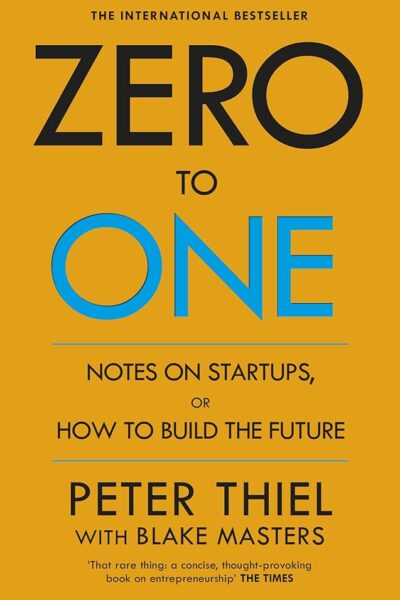
Peter Thiel’s influential book Zero to One challenges entrepreneurs to think fundamentally differently about building successful companies. Rather than competing in existing markets, Thiel argues that the most valuable businesses create entirely new categories. Drawing from his experience co-founding PayPal and investing in companies like Facebook and SpaceX, Thiel presents a contrarian framework for innovation that has shaped how a generation of entrepreneurs approaches building startups.
The Central Question: What Important Truth Do Very Few People Agree With You On?
Thiel opens with what he calls the contrarian question, one that forces you to think independently rather than accepting conventional wisdom. This question matters because the best business ideas often look wrong to most people at first. If everyone already agrees that something is a good idea, the opportunity has probably already been exploited.
Great companies are built on secrets, truths that are important but hidden or not widely believed. Finding these secrets requires thinking from first principles rather than copying what has worked before. It demands intellectual courage to pursue ideas that others dismiss or haven’t considered.
Zero to One vs. One to N: The Difference Between Innovation and Replication
The book’s title captures a fundamental distinction. Going from zero to one means creating something entirely new, bringing into existence something that didn’t exist before. Going from one to n means copying or scaling something that already exists.
Globalization represents going from one to n. Taking things that work in one place and making them work everywhere else is valuable but fundamentally different from innovation. Technology, by contrast, represents going from zero to one. It’s about vertical progress, creating new capabilities rather than horizontal expansion.
Thiel argues that while both matter, zero to one innovations create far more value and face less competition. The challenge is that true innovation is harder to plan and predict than replication. You can’t create the future by following a formula or best practices because by definition you’re doing something new.
The Power of Monopoly: Why Competition Is for Losers
One of the book’s most provocative claims is that competition is destructive and monopoly is the condition of every successful business. This contradicts everything we learn in economics classes, but Thiel makes a compelling case.
In perfectly competitive markets, no company makes economic profit in the long run. Competition drives margins to zero. Businesses spend all their energy fighting rivals rather than creating value. By contrast, monopolies can focus on their products, their employees, and long-term planning because they aren’t locked in existential competitive battles.
The key is understanding what Thiel means by monopoly. He’s not talking about coercive monopolies protected by government or illegal monopolies that harm consumers. He means creative monopolies, companies so good at what they do that no other firm can offer a close substitute. Google has a creative monopoly in search. It became dominant not through illegal behavior but by being dramatically better than alternatives.
How to Build a Monopoly
Thiel identifies four characteristics of successful monopolies. Proprietary technology that is at least 10 times better than the closest substitute creates a real competitive advantage. Google’s search algorithms were vastly superior to existing options when it launched. Network effects make products more valuable as more people use them, as with Facebook or telephone networks. Economies of scale mean the business gets stronger as it grows larger, spreading fixed costs across more customers. Strong branding matters, though Thiel notes it must be backed by substance.
The path to monopoly starts small. You must dominate a specific niche before expanding. Amazon began with books, not as “the everything store.” Facebook started at Harvard before expanding to other universities, then the world. Starting with a small market sounds limiting but actually gives you the beachhead you need. It’s much easier to dominate a small market than to be a bit player in a large one.
Once you dominate your niche, you can expand into related markets. Amazon went from books to other media, then to general merchandise. Each step leveraged existing advantages while expanding reach. This sequential approach beats trying to address massive markets from day one.
The Importance of Distribution
Engineers often believe that building a great product is sufficient for success. Thiel forcefully rejects this assumption. Superior sales and distribution are as important as the product itself. If you build something great but can’t get it to customers, you have nothing.
The best products don’t always win. Consider VHS versus Betamax, or Windows versus Mac in the 1990s. Distribution advantages often matter more than technical superiority. Yet founders, especially technical founders, systematically undervalue sales and distribution. They view it as somehow less legitimate than engineering.
Effective distribution requires matching your distribution method to your economics. Enterprise software with high contract values justifies expensive personal selling. Consumer products with small unit economics need viral growth or effective advertising. The distribution strategy must align with your product and margins.
Secrets and the Importance of Contrarian Thinking
Every great business is built around a secret, something important and unknown that you’ve discovered. These secrets exist in the space between what everyone knows is true and what is impossible. They’re things that are hard but doable, hidden but findable.
Thiel distinguishes between secrets of nature, undiscovered facts about the physical world, and secrets about people, things people don’t know about themselves or aren’t telling you. Many of the best startup opportunities involve secrets about people. Airbnb discovered that people would let strangers stay in their homes. Uber found that people would get in cars with strangers. These weren’t obvious truths but they turned out to be correct.
Finding secrets requires asking questions others aren’t asking and looking at familiar things from new angles. What fields matter but haven’t been standardized or institutionalized? What are people not allowed to talk about? Where do people’s incentives diverge from the truth? The answers often point toward valuable secrets.
The Power Law: Why Most Things Don’t Matter
Venture capital returns follow a power law distribution. The best investment in a successful fund often equals or exceeds the returns from all other investments combined. This has profound implications for how venture capitalists should think and how founders should understand their businesses.
For founders, the power law means you should only start a company if you believe it could become extremely valuable. Marginal businesses aren’t worth the years of your life they’ll consume. It also means thinking carefully about joining companies. Joining the right company at the right time matters enormously for your career trajectory and wealth.
The power law also applies within companies. Not all efforts create equal value. Some products, features, or distribution channels will matter vastly more than others. The challenge is identifying which things follow the power law in your specific context and concentrating resources accordingly.
Foundations: Getting the Start Right
Thiel emphasizes that early decisions at a company have profound and lasting consequences. Choosing the right co-founder is like getting married, a relationship that’s hard to exit and foundational to everything that follows. You need aligned values, complementary skills, and genuine mutual trust.
Equity distribution among founders and early employees sets precedents and creates expectations that are nearly impossible to change later. Getting this wrong causes lasting friction and resentment. The same applies to your first hires. Each person shapes company culture and attracts similar people.
Board composition matters immensely. Thiel advocates for small boards of three to five people. Large boards are ineffective because they’re easier for executives to control and harder to coordinate. Every board member should be deeply committed and engaged, not just collecting fees and prestige.
The Role of Sales in Your Company
One of Thiel’s key insights is that everyone has to sell regardless of their role. CEOs must sell the company vision to employees, investors, and partners. Engineers must sell their ideas internally. Even if you have a sales team, selling remains everyone’s job to some degree.
Different distribution channels suit different products and margins. Complex enterprise sales with million dollar contracts justify having senior executives spend months courting customers. Mid-range products in the tens of thousands might need a traditional sales force. Lower-priced products require distribution methods that don’t involve personal selling, like viral growth or online advertising.
The crucial error is having no distribution strategy or assuming your product will sell itself. This rarely happens even with exceptional products. You must actively solve the distribution problem with the same creativity and rigor you applied to building the product.
Seeing Green: The Cleantech Bubble as Cautionary Tale
Thiel uses the cleantech bubble of the 2000s as an extended case study of what not to do. Hundreds of cleantech companies failed despite brilliant founders, important problems, and massive investment. Their failure illustrates several key mistakes.
Many cleantech companies had no technological breakthrough. They assumed incremental improvements on existing solar or battery technology would somehow succeed where previous attempts failed. Without proprietary technology at least 10 times better than alternatives, they had no real advantage.
Others misjudged timing, believing cleantech was the future without asking whether the future was now. Being right about long-term trends doesn’t help if you’re a decade early. Still others underestimated competition, assuming clean energy would naturally triumph without recognizing they were entering brutally competitive markets against entrenched incumbents.
The cleantech bubble also revealed the danger of following trends. When everyone rushes into a sector, competition intensifies and returns decline. The best opportunities often look unpromising to most observers.
The Founder’s Paradox
Thiel closes with a fascinating observation about founders. They’re often extreme people, not normal or well-balanced. They might be brilliant and eccentric, charismatic and polarizing, visionary and impractical. This extremity often correlates with their ability to build important companies.
Society has an ambivalent relationship with founders. We celebrate them when they succeed and scapegoat them when they fail. Founders become symbols, both credited with outsized impact and blamed for failures often beyond their control. Understanding this dynamic helps both founders and those who work with them.
The most important thing founders can do is to create value. The best founders don’t just create wealth for themselves but build products and companies that genuinely improve people’s lives. This aligns private success with public benefit.
Thinking for Yourself in a World of Convention
The deepest theme running through Zero to One is the importance of independent thought. Schools teach you to follow rules and compete for predetermined prizes. Markets reward copying what works. Society enforces conformity in subtle and not-so-subtle ways.
Building something genuinely new requires rejecting these pressures and thinking from first principles. It means asking what you believe is true that others don’t yet see. It means having the courage to pursue ideas that seem wrong or impossible to most people.
This doesn’t mean being contrarian for its own sake. You’re not trying to be different, you’re trying to be right when others are wrong. That requires both independent thinking and rigorous reasoning. You must understand conventional wisdom well enough to know where and why it’s mistaken.
Practical Applications for Entrepreneurs
The insights from Zero to One translate into concrete guidance for building companies. Start by identifying a specific problem you can solve dramatically better than existing solutions. Don’t enter existing competitive markets hoping to execute slightly better than incumbents. Find or create new markets where you can dominate.
Think carefully about your initial market. Start small with a concentrated group of customers you can truly serve and satisfy. Resist the temptation to immediately chase larger markets before you’ve proven yourself in a smaller one.
Build proprietary technology that creates a real moat around your business. Being incrementally better isn’t enough. You need to be radically superior in some important dimension that customers care about and competitors can’t easily replicate.
Take distribution as seriously as product development. The best product with poor distribution loses to a good product with great distribution. Design your distribution strategy from the beginning based on your unit economics and customer characteristics.
Finally, surround yourself with the right people. Choose co-founders carefully based on complementary skills and shared vision. Build a culture that attracts independent thinkers who can handle the ambiguity and challenge of creating something new.
Why Zero to One Matters Now
In a world increasingly shaped by technology, the ability to create genuinely new things becomes more valuable over time. Copying and competing in existing markets faces intensifying global competition. Creating new markets and categories offers a path to building valuable, lasting companies.
Thiel’s framework helps entrepreneurs avoid common traps like entering crowded markets, underinvesting in distribution, or pursuing trends rather than truths. It provides a mental model for thinking about competition, innovation, and value creation that differs sharply from conventional startup advice.
The book’s influence extends beyond individual companies. Thiel’s ideas about monopoly, secrets, and contrarian thinking have shaped how investors evaluate opportunities and how entrepreneurs frame their ambitions. The focus on creating something genuinely new rather than iterating on existing ideas has pushed many founders toward more ambitious visions.
Whether you’re starting a company, making career decisions, or simply trying to think more clearly about the future, Zero to One offers a powerful framework. It challenges you to question assumptions, think independently, and focus on creating genuine value rather than competing for scraps in existing markets. In an era of rapid change and increasing competition, the ability to go from zero to one may be the most important skill of all.